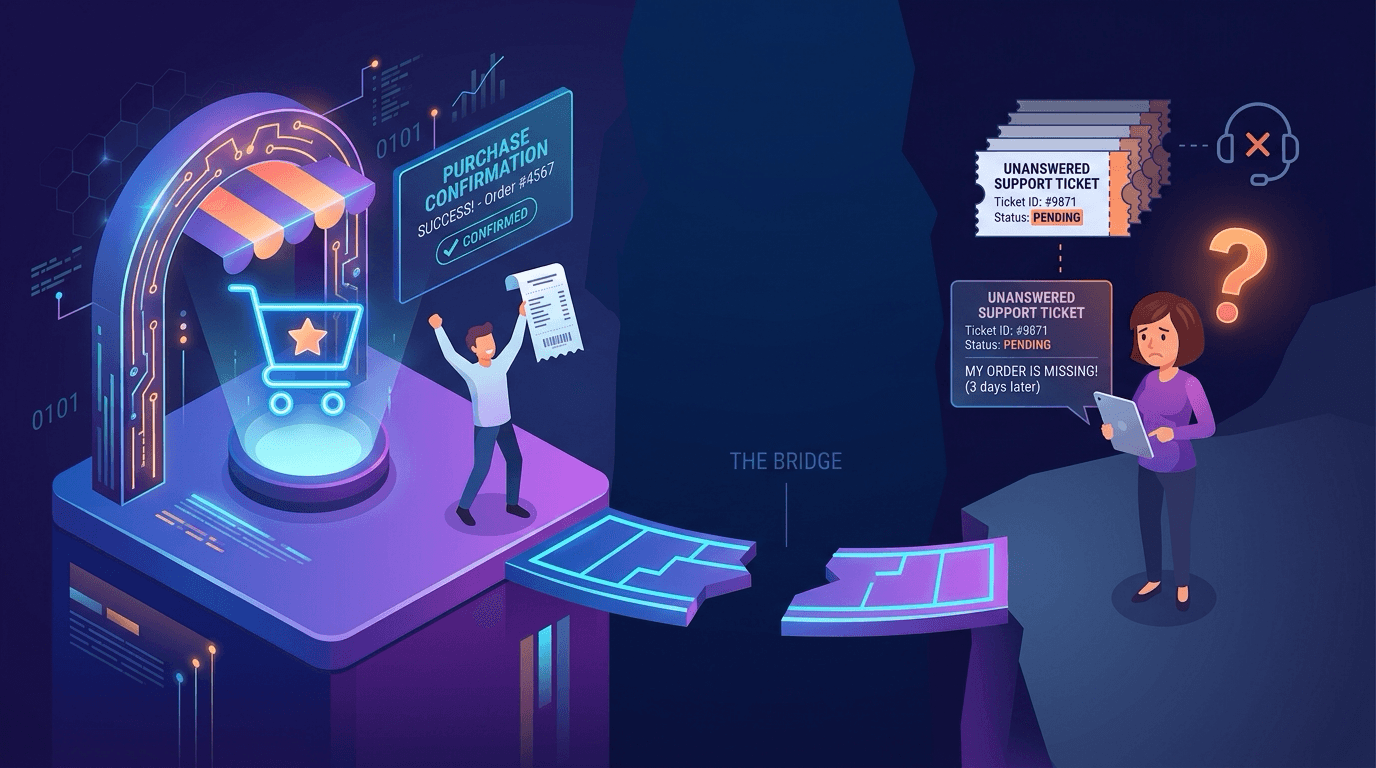
If you've been paying attention to Shopify lately, you've probably seen the buzz around AI storefronts and agentic commerce.
The short version: customers can now discover and buy products directly inside ChatGPT. No browsing your site, no scrolling collections, no abandoned cart emails. A shopper asks ChatGPT for a recommendation, your product shows up, and they check out right there in the conversation.
It's a genuine shift in how people find and buy things online. And Shopify's making it easy for merchants to plug in.
But here's the part nobody's talking about yet.
What happens after the sale?
More AI sales means more support emails
Right now, all the attention is on the front end. Product discovery. Checkout. Conversion. That makes sense — it's new, it's exciting, and it's a real growth opportunity for merchants.
But every order that comes through your store, whether it starts from Instagram, Google, or a ChatGPT conversation, ends up in the same place: your inbox.
Orders still need to be packed and shipped. Tracking still needs to update. Customers still have questions.
And when your store starts getting more orders from new channels, the support volume goes up too. That's just math.
The AI storefront handles the sale. Nobody's handling what comes next.
The emails that actually eat your time
If you run a Shopify store, you already know what fills your inbox. It's the same handful of questions, over and over:
- Where's my order? The tracking hasn't updated. The delivery window passed. The customer just wants to know what's going on.
- I need to return this. Wrong size. Wrong colour. Changed their mind. They want to know the process.
- This isn't what I ordered. Wrong item shipped. Damaged in transit. Missing from the package.
- Can I change my address? They moved. They entered the wrong details. The order already shipped.
- I never got a shipping confirmation. It went to spam. Or it hasn't shipped yet. Either way, they're worried.
None of these are complicated. Most have straightforward answers. But they take time — especially when you're answering the same ones twenty or thirty times a week.
And the more orders you're processing, the more of these show up.
AI storefronts will amplify this problem
Here's the thing about AI-driven product discovery: it removes friction from buying. That's the whole point. Fewer steps, faster decisions, more conversions.
But faster buying doesn't mean faster shipping. And it doesn't mean fewer questions.
If anything, customers coming through AI shopping channels might have more questions. They didn't browse your site. They might not have read your shipping policy. They might not even know your brand name. They asked ChatGPT for a product, it showed yours, and they bought it.
Now they've got an order from a store they've never heard of, and when the tracking doesn't update in two days, they're going to email you.
That's not a problem with AI commerce. It's just how ecommerce works. But as the front end gets smarter, the back end needs to keep up.
Why generic AI tools don't solve this
You might be thinking, well, if AI can sell the product, surely it can handle the support too.
Not quite.
General-purpose AI tools — the ones that summarise emails, draft replies, help you hit inbox zero — are useful for a lot of things. But ecommerce support isn't generic email.
When a customer asks about order #4721, a helpful reply needs to include the actual shipping status, the real tracking link, and the correct delivery window based on your carrier and location. A tool that doesn't have access to your Shopify store, your order data, and your policies can't give that answer.
It can guess. It can write something that sounds polite. But polite and wrong isn't support — it's a second email waiting to happen.
Ecommerce support is specific. It depends on real data: orders, tracking numbers, return windows, product details, store policies. Without that context, any reply is just filler.
What purpose-built support actually looks like
This is where the approach matters more than the tool.
Support that actually works for ecommerce stores isn't about writing faster emails. It's about understanding the email in the context of the order, the customer, and the store.
That means knowing what the customer bought. Knowing when it shipped. Knowing whether the return window's still open. Knowing your store's tone and policies. And using all of that to write a reply that actually resolves the issue.
That's what Regards Kim does.
It connects to your Shopify store and reads your customer emails with full context — order details, tracking status, store policies, previous conversations. When a customer emails about a late delivery, it doesn't guess. It checks. When someone asks for a return, it checks whether they are inside the return window and gives you the right context to reply.
You review and send from your inbox. The work moves faster without you spending your morning copying tracking links.
It's not about replacing you. It's about handling the repetitive stuff so you can focus on the parts of your business that actually need you.
The gap is real, and it's growing
AI storefronts are going to bring more customers to more stores. That's great. More sales, more growth, more opportunity.
But every one of those sales comes with a customer who might need help after they buy. And right now, most merchants are still handling that manually — one email at a time.
The front of the funnel's getting automated. The back end doesn't have to stay stuck.
If you're a Shopify store owner watching the AI commerce wave build and wondering how you're going to keep up with support as orders grow, it's worth thinking about this now — before the inbox gets out of hand.
Regards Kim auto-drafts Shopify support email replies from real order context.
Kind regards, Kim
Related posts
Keep reading
April 28, 2026
ChatGPT Shopping and Your Shopify Store: What You Need to Know
ChatGPT shopping is changing how customers discover and buy products. Here is what Shopify store owners should pay attention to next.
Read post →April 28, 2026
How to Automate Shopify Support Emails
A practical guide to automating Shopify support emails without sounding robotic or losing control of the customer experience.
Read post →April 1, 2026
Why Generic AI Email Tools Fall Short for Ecommerce Support
Generic AI email tools help with inbox clutter. Regards Kim is different because it is built for Shopify support, real store data, and approved support workflows.
Read post →