If customer support is starting to take over your week, you usually end up looking at two options.
Option one: hire a virtual assistant.
Option two: use AI.
Both can help. Both have weaknesses. And despite the hype on both sides, this is not really a “which one is better forever?” question. It is more about what stage your store is at and what kind of support load you actually have.
So here is the honest version from a store-owner perspective.
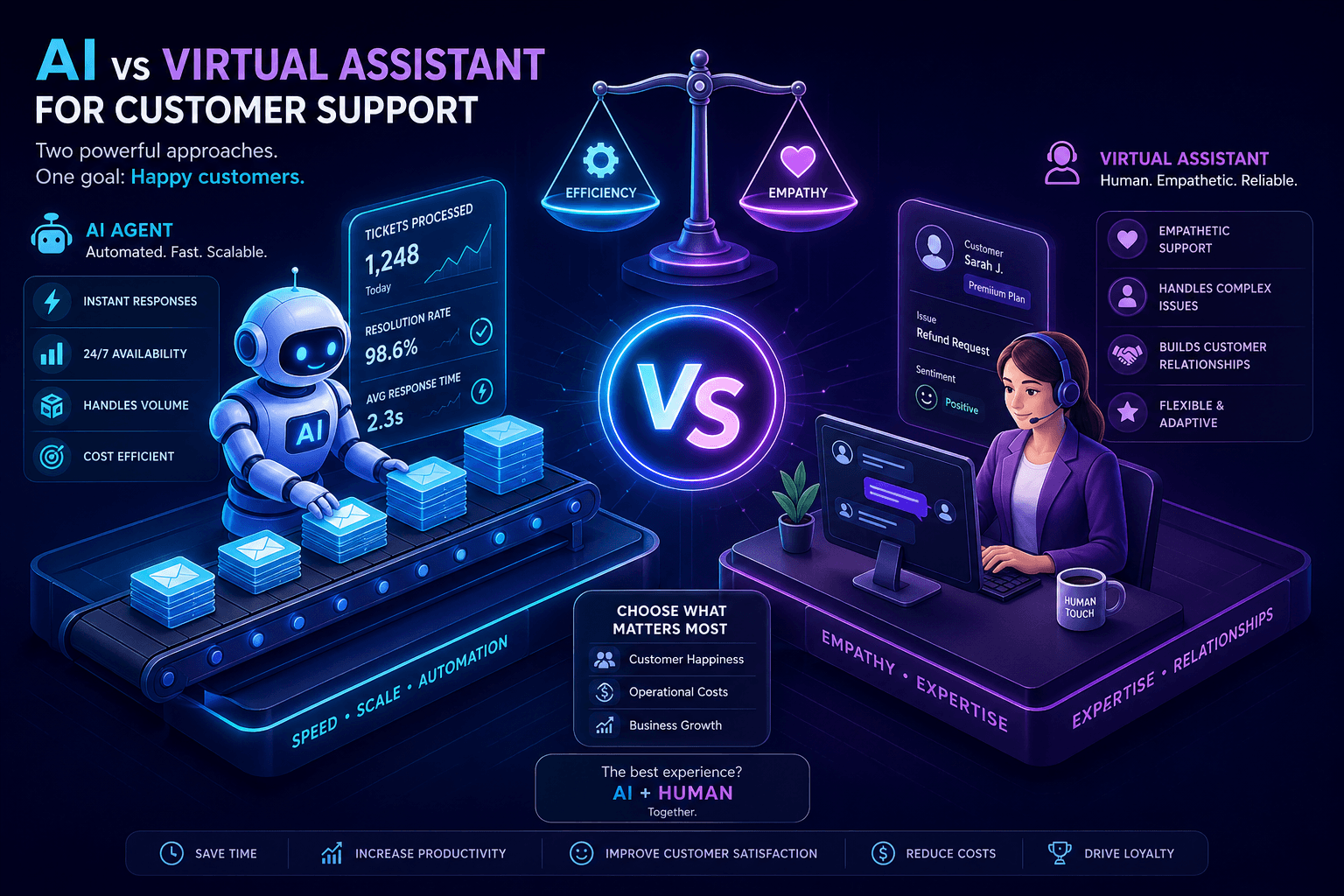
Where AI is better
AI wins on cost, speed, and availability.
If you can get useful support help for $49 per month, that is not remotely comparable to paying a human, even part-time. A virtual assistant may still be affordable compared with local hiring, but it is still a real monthly expense, usually in the hundreds or thousands depending on hours and skill.
AI also does not have shifts. It does not sleep, take leave, or wait for Monday morning. If an email comes in at 11:40 pm, the system can still classify it, pull context, and prepare a reply.
That matters more than people think. A lot of support stress comes from backlog, not just from the act of replying. If drafts are already prepared when you open the inbox, your mornings feel very different.
Where a virtual assistant is better
A good VA is better at nuance.
They can read tone properly, spot hidden frustration, make judgment calls, and deal with messy situations that do not fit into neat categories. They can also help beyond support if you need them to. Maybe they update spreadsheets, chase suppliers, handle admin, or jump into other tasks when the inbox is quiet.
Software does not give you that flexibility.
A real person can also become part of the business. They learn your products, your style, your regular customers, and your standards in a way that feels more human than even good automation.
The real question: what kind of support are you drowning in?
This is the key.
If 70 percent of your support is repetitive email like tracking updates, returns, shipping delays, and simple order questions, AI is often the smarter first move. Those are structured, predictable jobs. They do not need a whole human every single time.
If your support is messy, high-touch, emotionally sensitive, or spread across lots of weird edge cases, a VA becomes more valuable much sooner.
Most small Shopify stores are actually more repetitive than they think. The inbox feels chaotic because it arrives one message at a time, but once you zoom out, the same questions keep showing up.
Cost breakdown in real terms
Let us make this concrete.
A part-time ecommerce VA might cost anywhere from $400 to $1,500+ per month depending on hours, location, and experience. A stronger full-time support hire can cost much more.
On top of that, there is onboarding time. You need to document your policies, explain your products, review their replies, and stay available when they hit something unusual.
AI tools like RegardsKim sit in a different category. At $49 per month, the math is much easier. If it saves even two hours a month, it is probably already paid for itself. If it saves two hours a week, it is not even close. If you want a quick estimate for your own store, use the support cost calculator.
That does not mean AI replaces a great person. It means the cost threshold to try it is extremely low.
Management overhead matters more than people expect
Hiring a VA is not just buying help. It is taking on management.
You need to find the right person, train them, correct mistakes, handle turnover risk, and continuously keep them aligned with the business.
Sometimes that is worth it. Sometimes it is exactly the right move. But founders often underestimate how much of their own time still gets consumed in the process.
AI is weaker on human nuance, but stronger on operational simplicity. You connect it, review the output, and improve from there. No recruitment cycle. No scheduling. No handover risk.
The best answer is often both, just not at the same time
This is where I land for most stores.
Early on, AI usually makes more sense as the first layer. It takes the repetitive load off, keeps costs low, and helps you understand your support patterns better.
Later, if support keeps growing or starts requiring more human judgment, then a VA can be a strong next hire. At that point, you are hiring into a cleaner system instead of throwing a person into chaos.
And honestly, the two can work very well together. AI handles the predictable first draft work. A human handles escalations, relationship moments, and the edge cases that deserve extra care.
A simple way to choose
- If you need the cheapest and fastest relief, start with AI.
- If you need a person who can think across messy situations, hire a VA.
- If you are growing fast, AI first and VA later is often the most sensible sequence.
Final thought
This is not a battle between humans and software. It is a question of matching the tool to the work.
Repetitive Shopify support is exactly the kind of work AI should help with. Sensitive, unusual, or relationship-heavy situations are still where humans shine.
If your inbox is mostly the same few questions repeated every week, AI is probably the smarter first move. If your support needs someone who can improvise and represent the business deeply, a VA may be worth the extra cost.
The best support setups are not ideological. They are practical. If you want to run the numbers, try the support cost calculator or read our breakdown of the true cost of Shopify customer support.
Related posts
Keep reading
April 28, 2026
The True Cost of Customer Support for Shopify Stores
Customer support costs more than most Shopify founders think. Here is a real breakdown of time, hiring, tools, and why $49/month can be an easy win.
Read post →March 29, 2026
How to Scale Customer Support Without Hiring a Team
Learn how Shopify store owners can handle more customer support without hiring a full team or spending all day in the inbox.
Read post →April 28, 2026
How to Automate Shopify Support Emails
A practical guide to automating Shopify support emails without sounding robotic or losing control of the customer experience.
Read post →